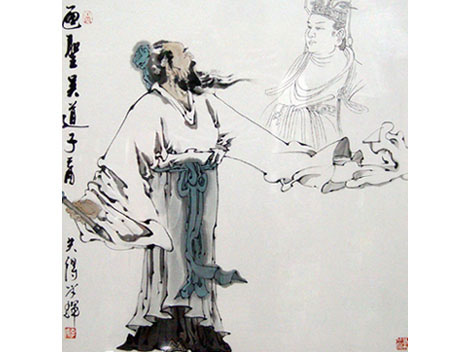
Chinese painter. Later known as Wu Daoxuan, he is a legendary figure said to have depicted human beings, landscapes, architecture, Buddhist deities, demons, birds and animals. Reportedly, he derived his inspiration from wine and had a mercurial, responsive brushstyle, producing breathtaking vistas of natural scenery and figures across vast areas of temple wall.
Wu Daozi(713-755)
Wu Daozi most prolific period was during the Kaiyuan and Tianbao eras (713-755) in the Tang Dynasty. Born in Yangzhai (Yu County in Henan Province), Wu lost both his parents at a young age and lived a hard life in his early years. He learned how to make a living from folk artists and sculptors. Because Wu studied hard and was talented in art, he earned himself a good reputation as a painter by the time he was 20 years old. Emperor Xuanzong invited Wu as an imperial painter in the court, naming him Daoxuan. As an imperial painter, Wu only painted at the emperor's request, which was a big restriction for a civilian painter. On the other hand, the court provided the best living conditions and was an outlet for artistic creativity.
Wu Daozi character was unrestrained, direct and indifferent to trivial matters, and it is known he always drank while painting. It is also said that when Wu drew the halo around Buddha's head in a mural, he only used his brushes without drafting the measurements first; when he painted at Longxing Temple, the temple was always packed with observers. Wu moved his brush quickly, and most of his works were accomplished in a single session. Chang'an (present day Xi'an), capital of the Tang Dynasty, was the cultural center of the time where many famous men of letters and artists lived. Wu had many opportunities to stay with them, which helped improve his painting skills.
Wu Daozi mainly created religious murals all his life and his abundant works had a wide range of subjects. According to records, Wu painted over 300 murals and more than 100 scrolls. While many of them involved Buddhism and Taoism, Wu also drew mountains, rivers, flowers and birds. The Presentation of Buddha is his most representative work. Unlike his predecessor Gu Kaizhi, whose line strokes were slender and forceful but lacked variety, Wu's strokes were full of change and vigor, expressing the internal world of his subjects. Wu was always in great ferment when he was painting, and his works exhibit an expressionist style.
Chinese painting is one of the oldest continuous artistic traditions in the world. The earliest paintings were not representational but ornamental; they consisted of patterns or designs rather than pictures. Early pottery was painted with spirals, zigzags, dots, or animals. It was only during the Warring States Period (475-221 BC) that artists began to represent the world around them. Painting in the traditional style is known today in Chinese as guó huà (国画), meaning 'national' or 'native painting', as opposed to Western styles of art which became popular in China in the 20th century. Traditional painting involves essentially the same techniques as calligraphy and is done with a brush dipped in black or colored ink; oils are not used. As with calligraphy, the most popular materials on which paintings are made of are paper and silk. The finished work can be mounted on scrolls, such as hanging scrolls or handscrolls. Traditional painting can also be done on album sheets, walls, lacquerware, folding screens, and other media.
One of the most famous paintings belonged to landscapes.
Painting was no longer about the description of the visible world; it became a means of conveying the inner landscape of the artist's heart and mind.
these paintings were so beautiful that the viewers were unable to know whether it was a picture or reality...... k Some of the paintings are given below...
For more knowledge you may watch this video ....
for further knowledge about chinese paintings and landscapes please go through wikipedia or web... thanks for exploring my blog....